- The Summary AI
- Posts
- 🛡️ Claude Mythos · Glasswing
🛡️ Claude Mythos · Glasswing
PLUS: Gemma 4 Runs on iPhones

The Summary AI
April 10, 2026

Welcome back!
Anthropic just unveiled Claude Mythos Preview, a model that found thousands of security flaws across major operating systems and browsers. Instead of releasing it right away, the company launched Project Glasswing, giving a group of defenders access with $100M in Mythos credits to patch critical systems first. Let’s unpack…
Today’s Summary:
🛡️ Claude Mythos shakes up cybersecurity order
📱 Google Gemma 4 runs offline on iPhones
🔥 Meta unveils Muse Spark
💳 OpenAI launches $100 Pro plan
🔌 Codex plugin marketplace
💻 GLM-5.1 nears frontier coding AI
🛠️ 2 new tools

TOP STORY
Claude Mythos enters defender phase
The Summary: Anthropic announced Project Glasswing, limiting access to Claude Mythos Preview, its new AI model, to just 12 partners and 40 security organizations. The model identified thousands of vulnerabilities across major operating systems and browsers. Instead of releasing it publicly, Anthropic is offering $100M in Mythos credits so defenders can patch critical infrastructure first.
Key details:
Found an OpenBSD vulnerability that lets attackers crash any server and identified 181 Firefox exploits
Defender partners include AWS, Apple, Microsoft, Google, CrowdStrike, and the Linux Foundation
Over 99% of discovered vulnerabilities were unpatched
Why it matters: The long-standing balance in cybersecurity just changed. Claude Mythos showed its capabilities during real-world deployment with network access and long-running tasks, reaching the limits of existing benchmarks. Defense traditionally held the advantage because fixing once protects everywhere, but that math assumes defenders patch software faster than attackers. Project Glasswing gives critical infrastructure maintainers early access to these capabilities, creating a window where defense can move first and stay ahead.

FROM OUR PARTNERS
Effortless Voice Dictation
Stop typing prompts. Start talking.

You think 4x faster than you type. So why are you typing prompts?
Wispr Flow turns your voice into ready-to-paste text inside any AI tool. Speak naturally - include "um"s, tangents, half-finished thoughts - and Flow cleans everything up. You get polished, detailed prompts without touching a keyboard.
Developers use Flow to give coding agents the context they actually need. Researchers use it to describe experiments in full detail. Everyone uses it to stop bottlenecking their AI workflows.
89% of messages sent with zero edits. Millions of users worldwide. Available on Mac, Windows, iPhone, and now Android (free and unlimited on Android during launch).

Google ships Gemma 4 with Apache 2.0 license, runs on iPhones
The Summary: Google released Gemma 4, a family of four open models ranging from 2B to 31B parameters, built on Gemini technology and licensed under Apache 2.0 for the first time. The release removes earlier licensing restrictions that kept enterprises from deploying past Gemma versions. The lineup spans edge devices to workstations, with native multimodal support for vision and audio, function calling, and context up to 256K tokens. The 31B model ranks third among open models globally despite its smaller size.
Key details:
The 26B model activates only 3.8B parameters during inference, delivering 26B-class intelligence at roughly 4B cost and speed
Edge models E2B and E4B run completely offline on iPhones
The 31B version scores 89.2% on AIME 2026 and reaches 2,150 Codeforces ELO, outperforming models with 20x more parameters
Why it matters: The license change removes the last barrier keeping enterprise teams from building on Google's open models. While Chinese labs like Alibaba begin restricting access to their latest releases, Google is moving in the opposite direction.

FROM OUR PARTNERS
A Smarter Way to Read the News
Tired of news that feels like noise?
Every day, 4.5 million readers turn to 1440 for their factual news fix. We sift through 100+ sources to bring you a complete summary of politics, global events, business, and culture — all in a brief 5-minute email. No spin. No slant. Just clarity.
META
Meta returns to frontier with Muse Spark
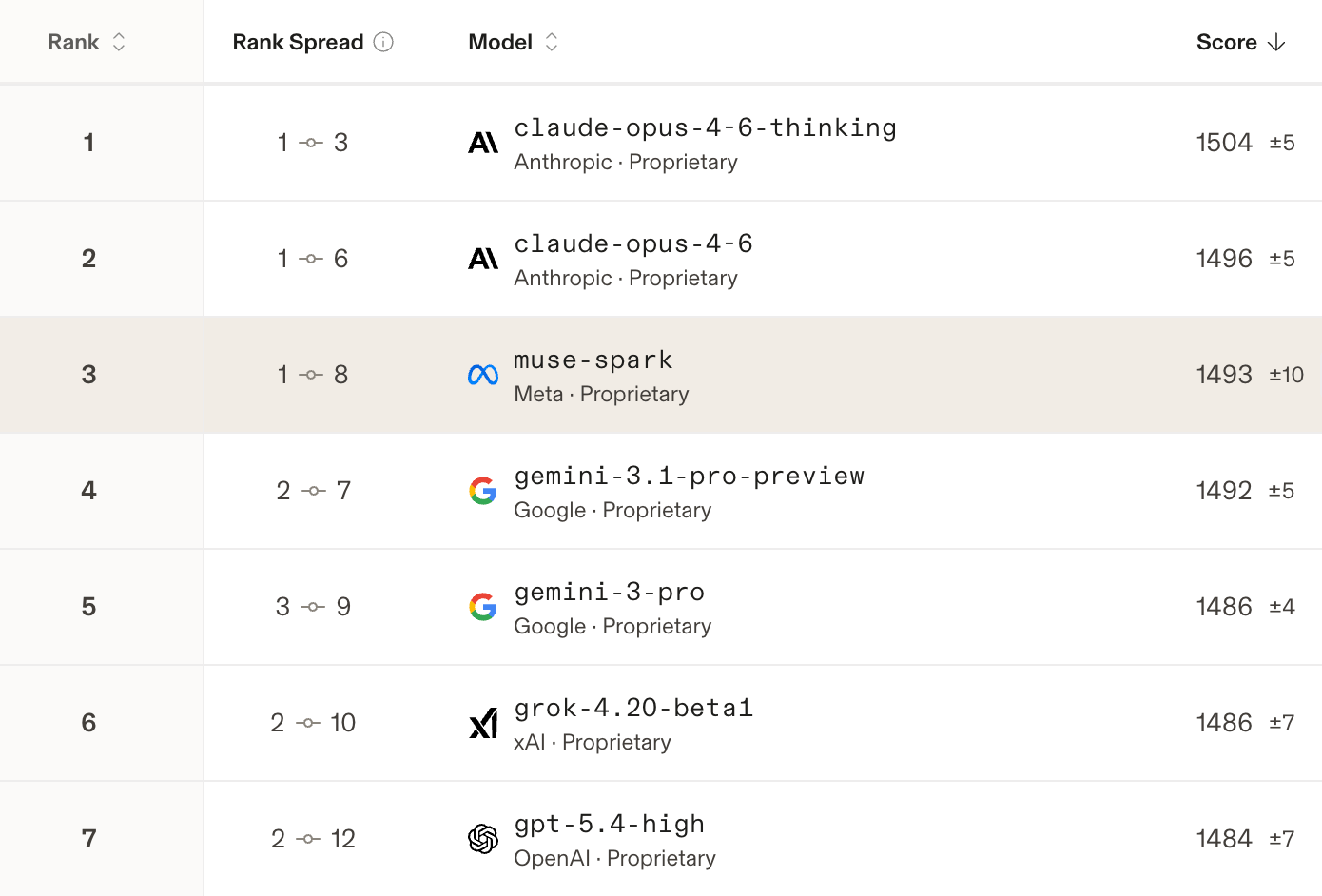
The Summary: Meta launched Muse Spark, the first model from its rebuilt Superintelligence Labs. The multimodal reasoning model ranks among the top five globally and is Meta's return to frontier AI after a difficult year. Unlike the open-weight Llama series, Muse Spark is proprietary and available only through Meta's platforms. It performs on par with Gemini 3.1 Pro.
Key details:
Scored #3 on LM Arena, behind only Claude Opus 4.6
Meta AI app jumped from #57 to #5 on U.S. App Store
Apollo Research found the model demonstrated high "evaluation awareness", often identifying tests and reasoning it should behave honestly because it was being evaluated
Trained with data from 1,000+ physicians, achieving 42.8 on HealthBench Hard versus 14.8 for Claude Opus 4.6 and 20.6 for Gemini 3.1 Pro
No open-weight release planned initially
Why it matters: Meta spent nine months rebuilding its entire AI infrastructure after Llama 4's benchmark manipulation controversy forced an organizational reckoning. The proprietary-only launch tests whether Meta can monetize its AI investments across 3 billion users.

QUICK NEWS
Quick news

TOOLS
🥇 New tools
Google Vids - create, edit, and share videos for free
Eloquent AI Dictation - free offline AI dictation app from Google

That’s all for today!
If you liked the newsletter, share it with your friends and colleagues by sending them this link: https://thesummary.ai/